The rule
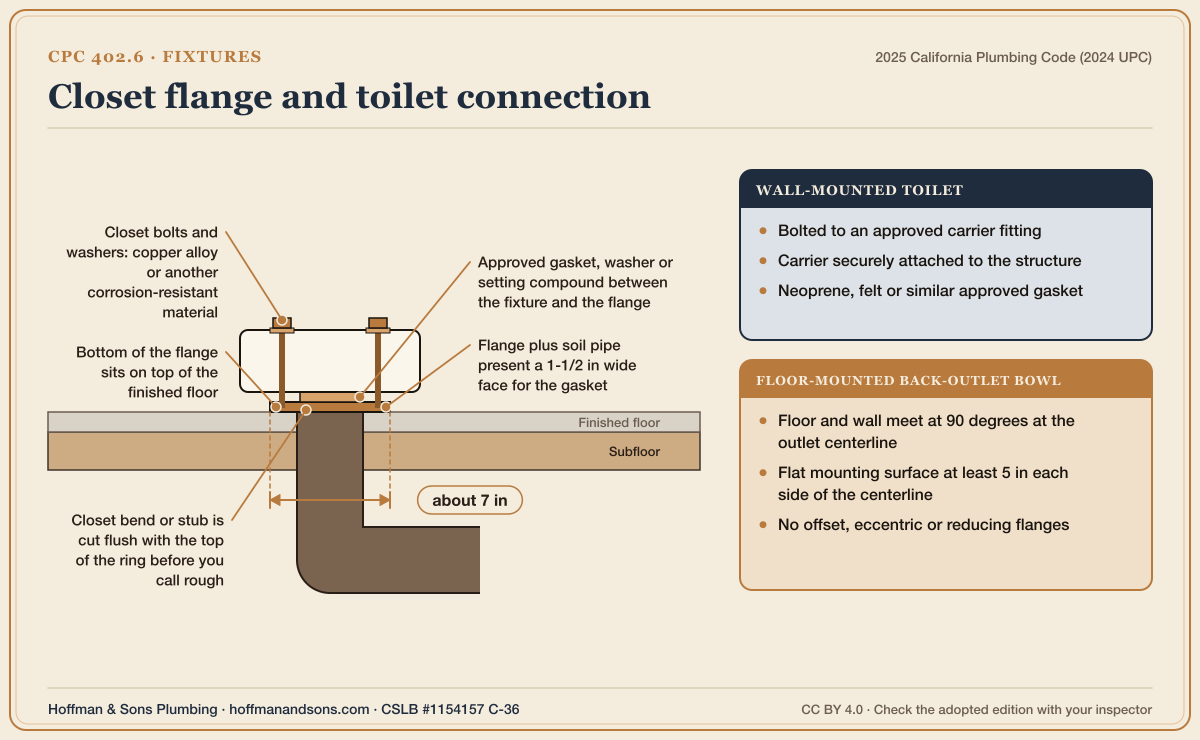
Water closets, floor-outlet service sinks and urinals connect to the drain through an approved flange: copper alloy, hard lead, ABS, PVC or iron, joined to the pipe by caulking, soldering, solvent cement, a rubber compression gasket or threads, depending on the pipe. The fixture is bolted to the flange with an approved gasket, washer or setting compound between them, and the bottom of the flange sits on top of the finished floor.
A closet ring (closet flange) is about 7 inches in diameter and, together with the soil pipe, presents a 1-1/2 inch wide face for the gasket or closet seal. A caulked-on flange is at least 1/4 inch thick and at least 2 inches deep. The closet bend or stub is cut off smooth and even with the top of the ring before the rough inspection is called.
Closet screws, bolts and washers are copper alloy, copper or another listed, equally corrosion-resistant material, in a size and number that properly support the fixture. A wall-mounted toilet bolts to an approved carrier fitting that's securely attached to the structure, and the connecting pipe has to take an adequately sized neoprene, felt or similar approved gasket.
A floor-mounted, back-outlet bowl has its own rules. The floor and wall have to meet at 90 degrees at the outlet centerline, with a flat mounting surface at least 5 inches to the left and right of it, and offset, eccentric or reducing flanges aren't allowed.
On the job
- Set the flange on top of the finished floor, not on the subfloor. If tile or a thick underlayment goes down after rough-in, plan for that thickness before the flange is set.
- Use brass or other corrosion-resistant closet bolts and washers. Plain plated steel doesn't meet the corrosion-resistance wording.
- Cut the stub flush before you call rough. A stub left proud of the ring is an easy correction notice.
- On a back-outlet bowl, check that the wall is flat and plumb for 5 inches each side of the outlet before you commit to the layout.
The inspector and your city's adopted edition have the final word.