The rule
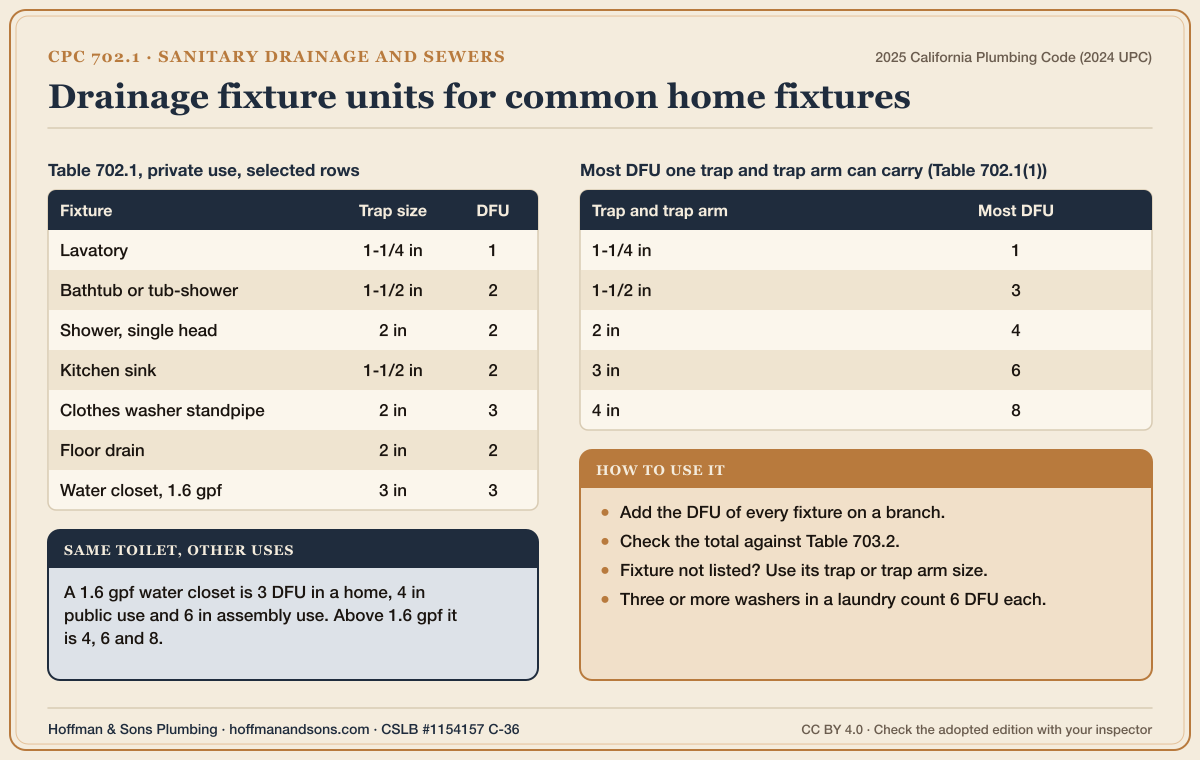
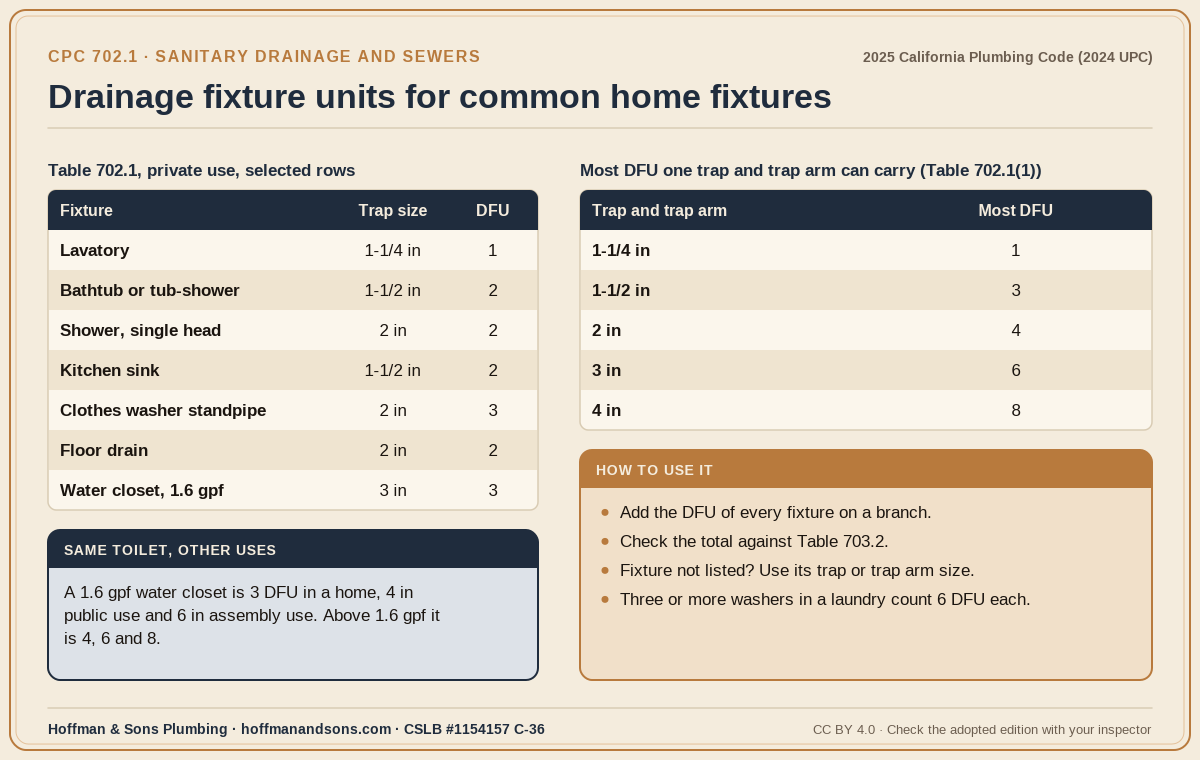
A drainage fixture unit is the code's way of rating how much load a fixture puts on the drain. Table 702.1 lists each fixture with its minimum trap and trap arm size and a DFU value, in three columns: private use (homes), public use, and assembly occupancies.
Typical private values: lavatory 1 (1-1/4 inch trap), bathtub or tub-shower 2 (1-1/2 inch), shower 2 (2 inch), kitchen sink 2 (1-1/2 inch), domestic clothes washer standpipe 3 (2 inch), floor drain 2 (2 inch), and a 1.6 gpf water closet 3 (3 inch). The same toilet counts 4 in public use and 6 in assembly use.
If a fixture isn't in the table, its unit value comes from the size of its trap or trap arm. Table 702.1(1) sets the most one trap can carry: 1 unit on a 1-1/4 inch, 3 on 1-1/2, 4 on 2, 6 on 3, and 8 on 4 inch.
Bigger isn't automatically better. The table's footnote says trap sizes can't be increased to the point where the fixture's discharge can no longer keep the trap scoured.
On the job
- Do the DFU tally on paper before you order pipe: add the fixtures on each branch, then add the branches that feed the building drain, and check each total against Table 703.2.
- Kitchen sinks, laundry sinks and domestic dishwashers carry a footnote calling for a 2 inch minimum drain, even though a kitchen sink trap is 1-1/2 inch.
- Three or more clothes washers in a laundry area are rated at 6 DFU each for sizing the shared horizontal and vertical piping, not the 3 you'd use for a single washer.
- A bathtub-to-shower retrofit can keep a 1-1/2 inch trap and trap arm if the shower is no bigger than 36 by 60 inches. Sections 408.6 and 408.7 have the details.
The inspector and your city's adopted edition have the final word.