Home › Code Library › CPC 910.4

CPC 910.4 · Vents

Combination waste and vent: pipe two sizes up

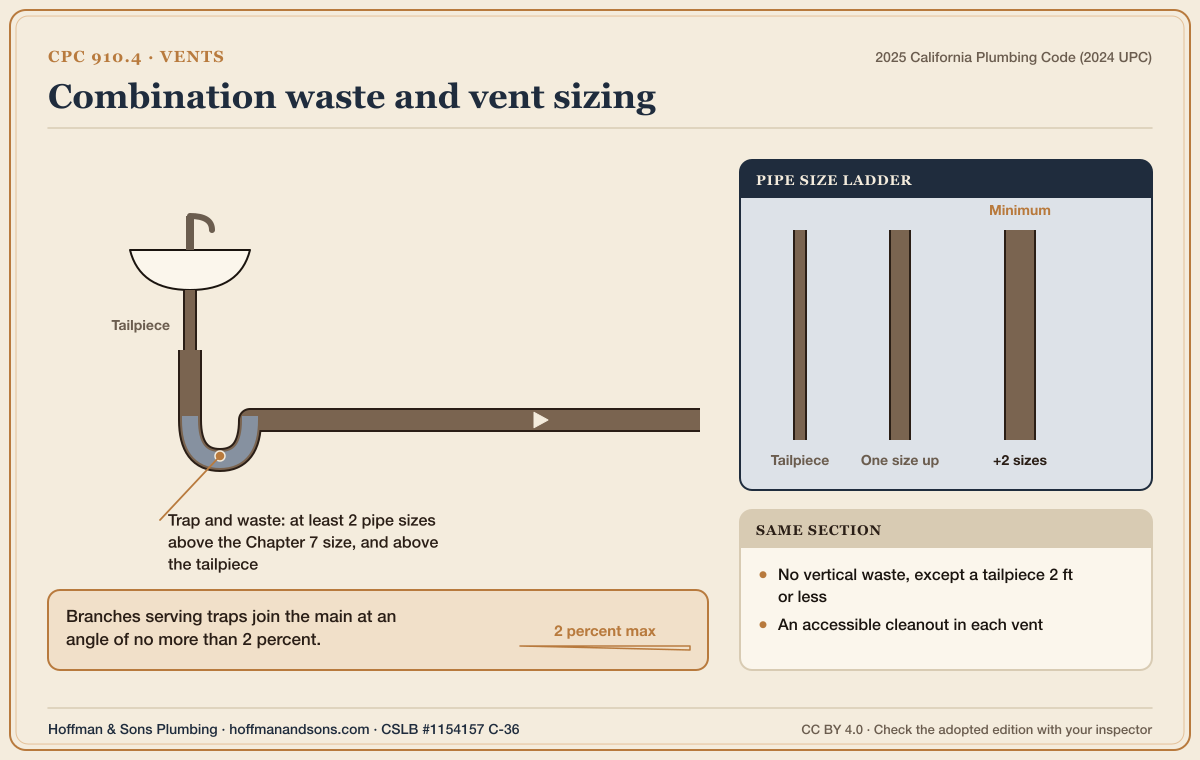
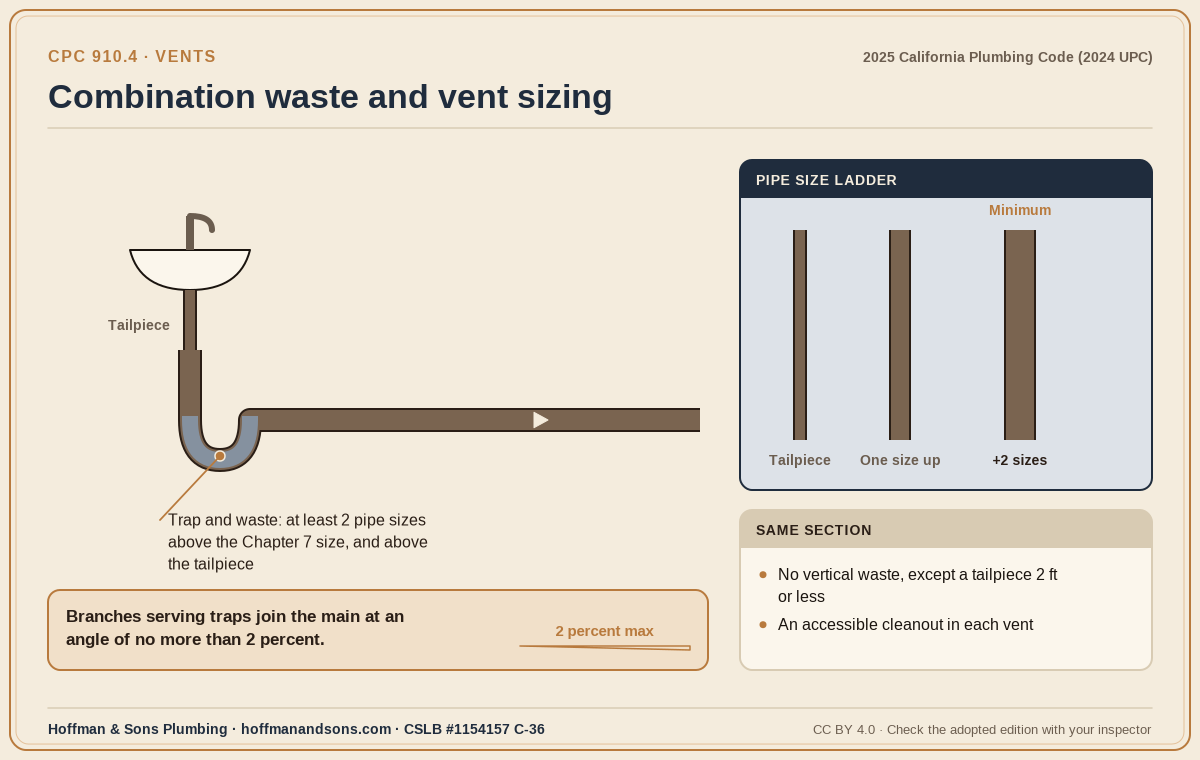
In a combination waste and vent, each waste pipe and each trap is at least two pipe sizes larger than Chapter 7 requires and two pipe sizes larger than the fixture tailpiece. Branches serving traps connect to the main line at an angle not exceeding 2 percent.

2025 California Plumbing Code, Chapter 9 (Vents) · Applies to: Homes and commercial buildings

A fixture tailpiece, trap and waste pipe drawn at increasing sizes, with the waste and trap two pipe sizes larger than both the Chapter 7 size and the tailpiece, and a branch joining the main nearly level.
Every waste pipe and trap goes up two pipe sizes over the Chapter 7 size and over the tailpiece, and branches join the main at no more than 2 percent. Diagram: Hoffman & Sons Plumbing (hoffmanandsons.com), CC BY 4.0. Free to share with credit. PNG · SVG · All diagrams

The rule

Because the oversized drain is what carries air, every waste pipe and every trap in the system is bumped up at least two pipe sizes over what Chapter 7 requires for the fixture. They also have to be at least two pipe sizes larger than the fixture tailpiece or connection.

Branches serving traps join the main line at an angle not exceeding 2 percent. That wording is short, so ask your inspector how they apply it.

Check the other limits in the same section: no vertical waste pipe except a short tailpiece (at most 2 feet), and a cleanout in each vent.

On the job

  • Check availability of the oversized traps and fittings early.
  • Do the size math fixture by fixture: take the Chapter 7 size, go up two sizes, then check it against the tailpiece.
  • Ask the inspector how the 2 percent angle rule will be applied on your job before you rough in.

The inspector and your city's adopted edition have the final word.

Give us a call

Call (760) 912-9831