The rule
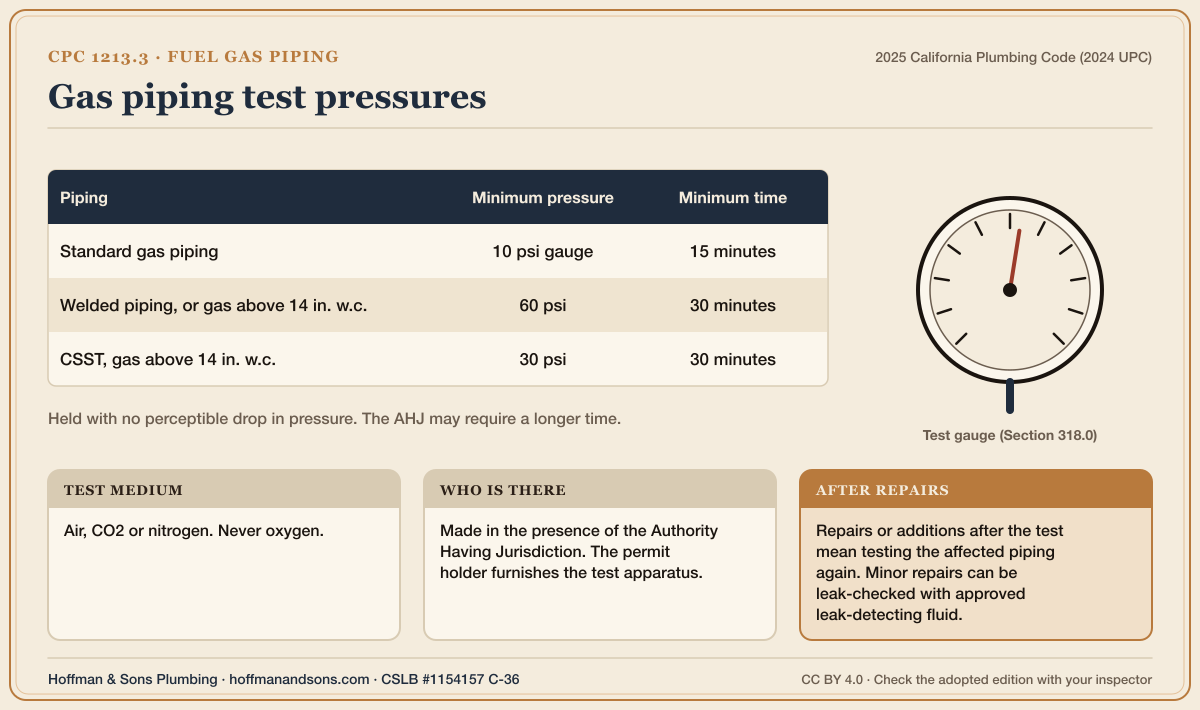
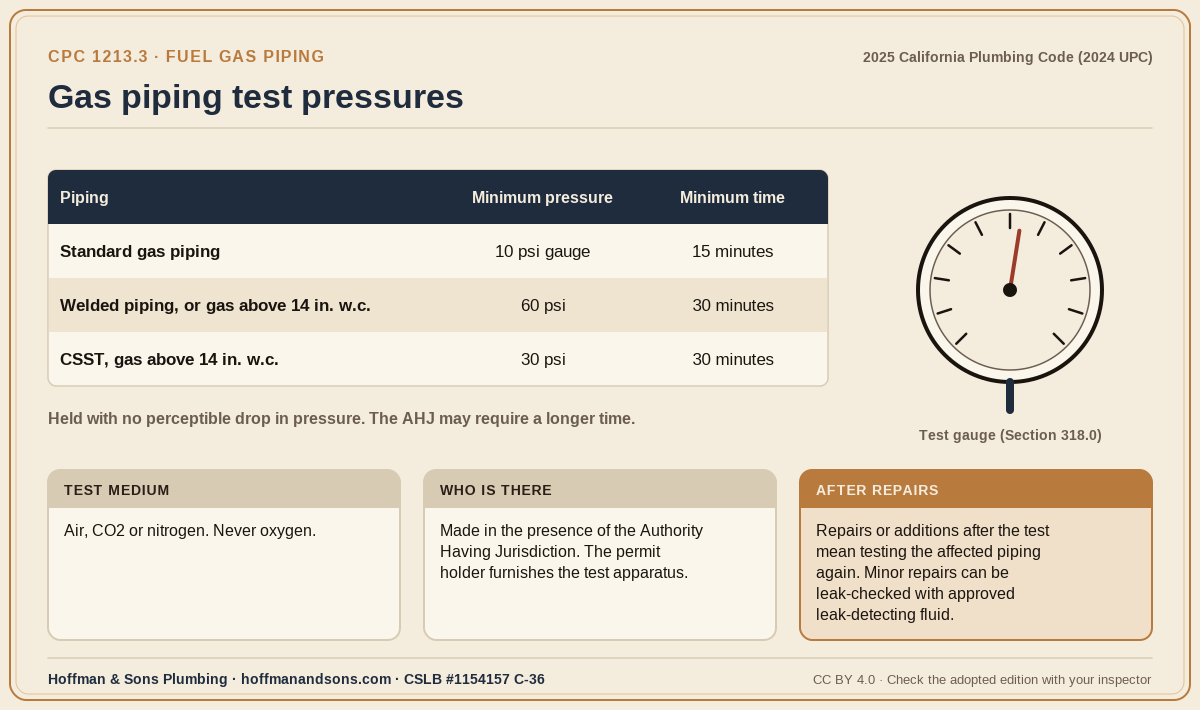
The basic gas piping test is an air, CO2 or nitrogen pressure test at not less than 10 psi gauge pressure. The pressure is held for a time the Authority Having Jurisdiction finds satisfactory, but never less than 15 minutes, with no perceptible drop in pressure.
For welded piping, and for piping carrying gas at more than 14 inches water column, the test pressure is not less than 60 psi, held for no less than 30 minutes (longer if the Authority Having Jurisdiction wants). For CSST carrying gas at more than 14 inches water column, the test is not less than 30 psi for 30 minutes.
The tests are made with air, CO2 or nitrogen, in the presence of the Authority Having Jurisdiction. The permit holder furnishes the test apparatus, and the gauges have to meet Section 318.0. Oxygen is never used as a test medium (Section 1213.1.6).
On the job
- Know the operating pressure of the system before you pick the test pressure. Low pressure systems get the 10 psi test, while anything above 14 inches water column gets the higher pressure.
- Check the pressure rating of regulators, valves and appliance controls, and keep them isolated from the test pressure. Test at the piping, not through the appliances.
- Let temperature settle. A drop that tracks the air temperature isn't a leak, but the inspector decides, so check the gauge before they arrive.
- Use a gauge with a range appropriate for the test pressure and in good condition. A pegged or low-range gauge is a correction.
The inspector and your city's adopted edition have the final word.