The rule
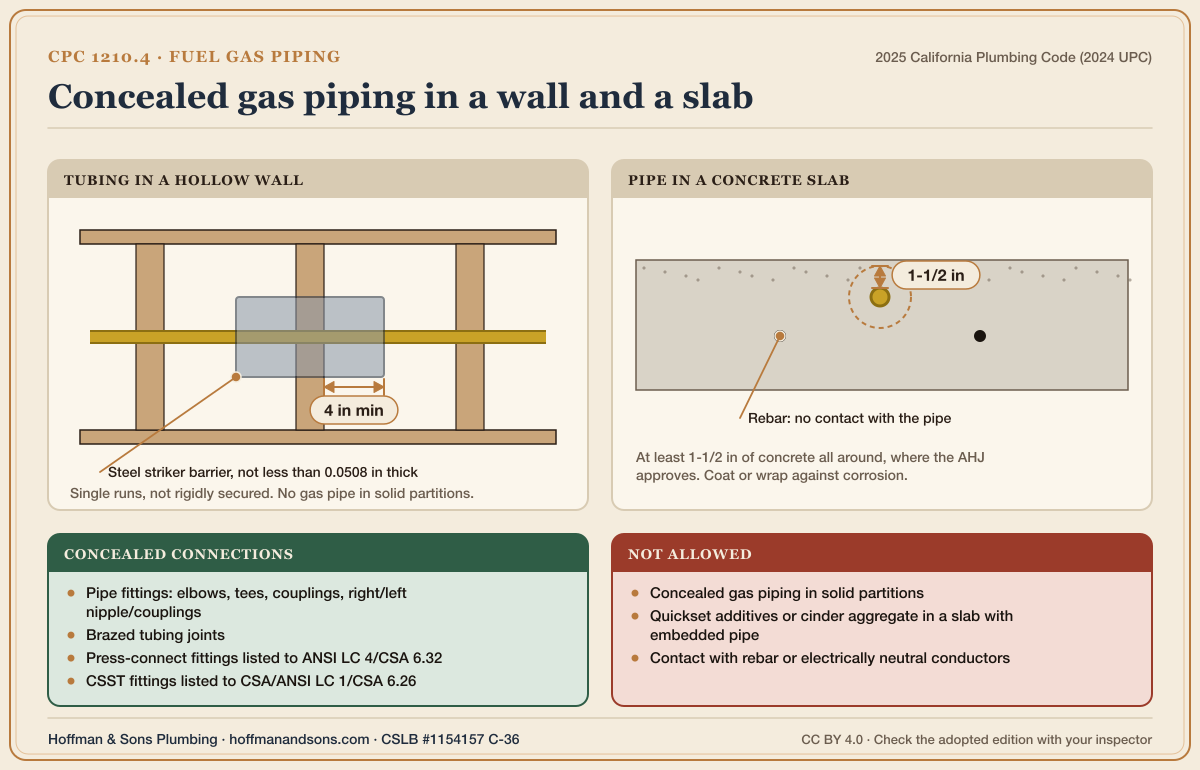
Anything buried in a wall or slab can't be inspected later, so the connections are limited. Concealed connections are made with pipe fittings (elbows, tees, couplings, right/left nipple/couplings), brazed tubing joints, press-connect fittings listed to ANSI LC 4/CSA 6.32, or CSST fittings listed to CSA/ANSI LC 1/CSA 6.26.
Concealed gas pipe can't be in a solid partition. Tubing in a hollow wall or partition without protection along its whole concealed length needs a steel striker barrier not less than 0.0508 of an inch thick (or equivalent) between the tubing and the finished wall, extending at least 4 inches beyond concealed penetrations of plates, firestops and studs. The tubing is run in single lengths and isn't rigidly secured.
In other than industrial occupancies, and where the Authority Having Jurisdiction approves, gas piping can be embedded in a portland cement concrete slab. It's surrounded by at least 1-1/2 inches of concrete, can't touch other metallic structures like reinforcing rods or electrically neutral conductors, and the pipe, fittings and risers have to be protected from corrosion. No quickset additives or cinder aggregate in the concrete.
In industrial occupancies, gas piping in solid floors is laid in channels and covered so it can be reached with minimal damage to the building.
On the job
- Pressure test and get the rough inspection before anything closes in. After that, a leak means opening walls.
- Set the striker barrier where the pipe passes the face of studs and plates, not just in the middle of a bay. Nails and screws land at the framing.
- Embedding gas pipe in a slab is an approval item. Get the OK from the Authority Having Jurisdiction before the pour, not at the inspection.
- Keep slab-embedded pipe off the rebar with chairs or spacers, and wrap or coat it per the corrosion protection rule.
The inspector and your city's adopted edition have the final word.