The rule
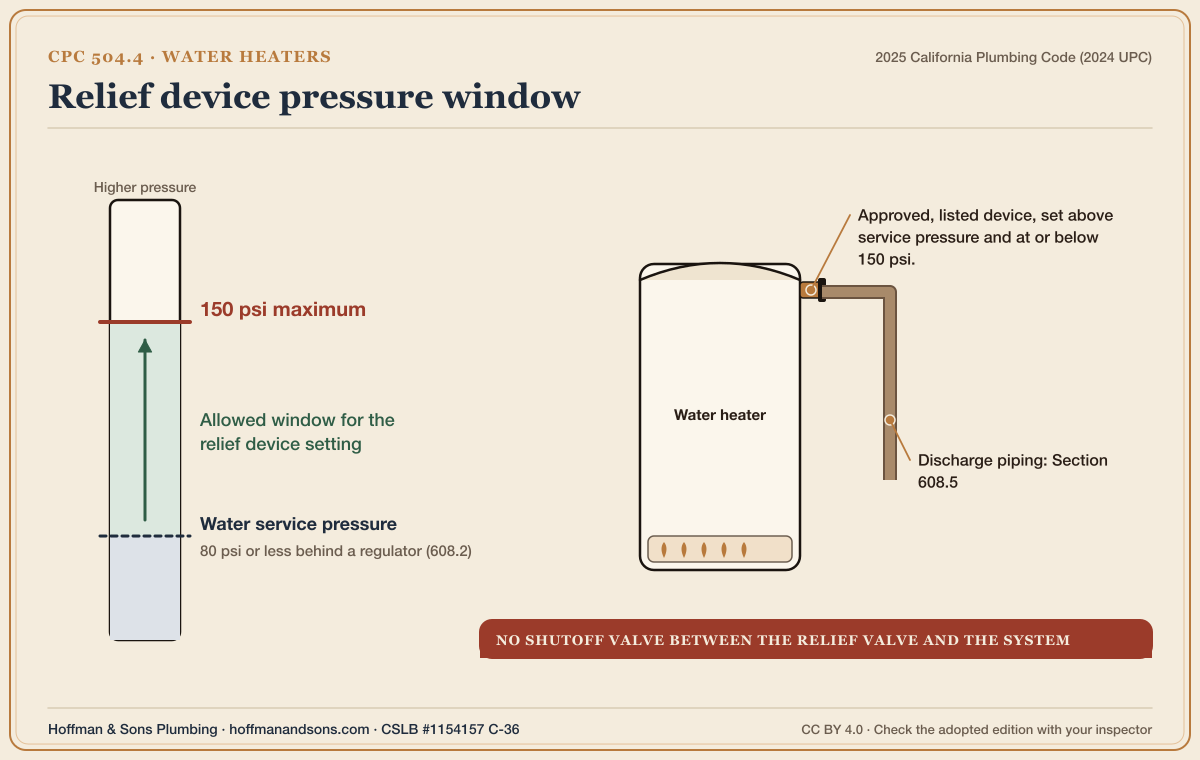
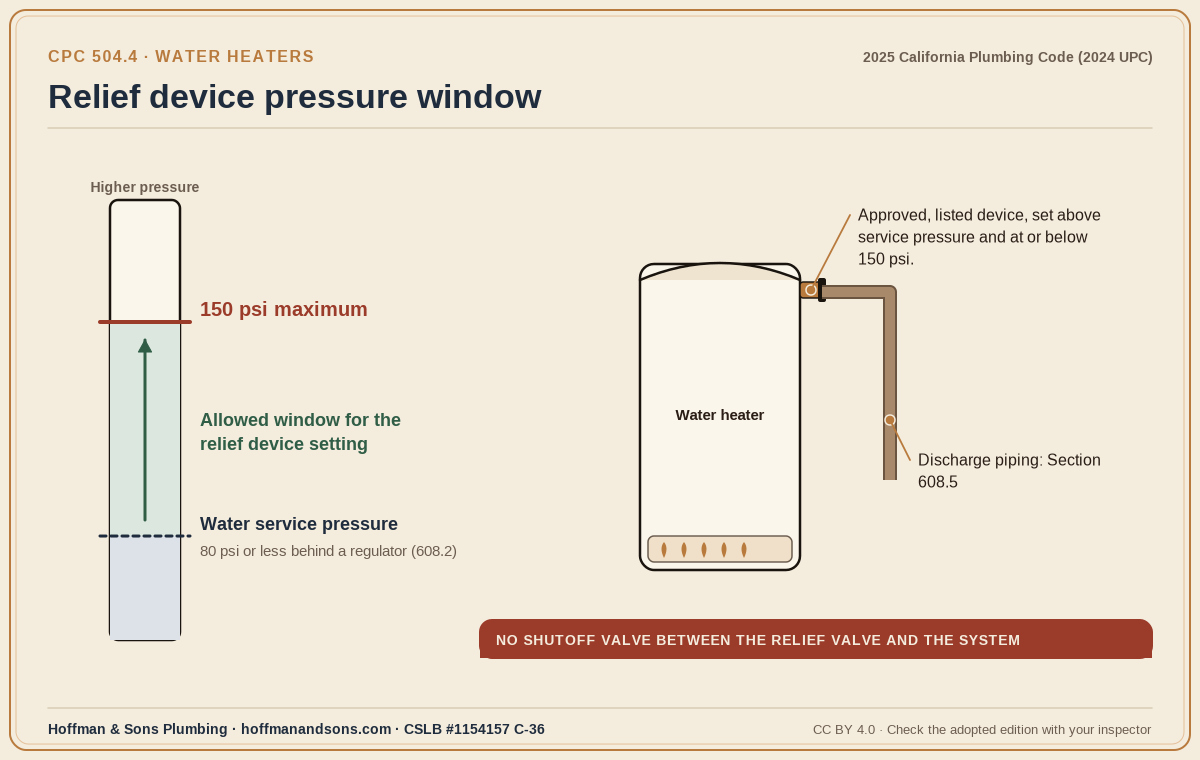
The installation has to have overpressure protection, and the device has to be approved and listed, installed per its listing and the manufacturer's instructions. On most residential heaters that device is the combination temperature and pressure (T&P) relief valve.
The pressure setting has two limits. It has to be above the water service pressure, or it would open every time the system sits at normal pressure. And it can't exceed 150 psi, which is the cap Section 608.4 puts on relief valves. That section also says the valve is an automatic type with a drain, and no shutoff valve goes between it and the system.
A closed system (for example, after a pressure regulator) can't absorb the swelling of heated water, so the pressure climbs and the relief valve takes the hit. The cure is an expansion tank under Section 608.2, not a higher-rated valve.
On the job
- Read the pressure rating stamped on the valve and check it against your static pressure. A valve that's rated near the house pressure will weep.
- A T&P that drips every heating cycle is usually telling you the system is thermally locked. Check the expansion tank and the regulator before you swap the valve.
- Never plug or cap the valve to stop a drip. The device is there so the heater can't be pressurized past its limit.
The inspector and your city's adopted edition have the final word.