The rule
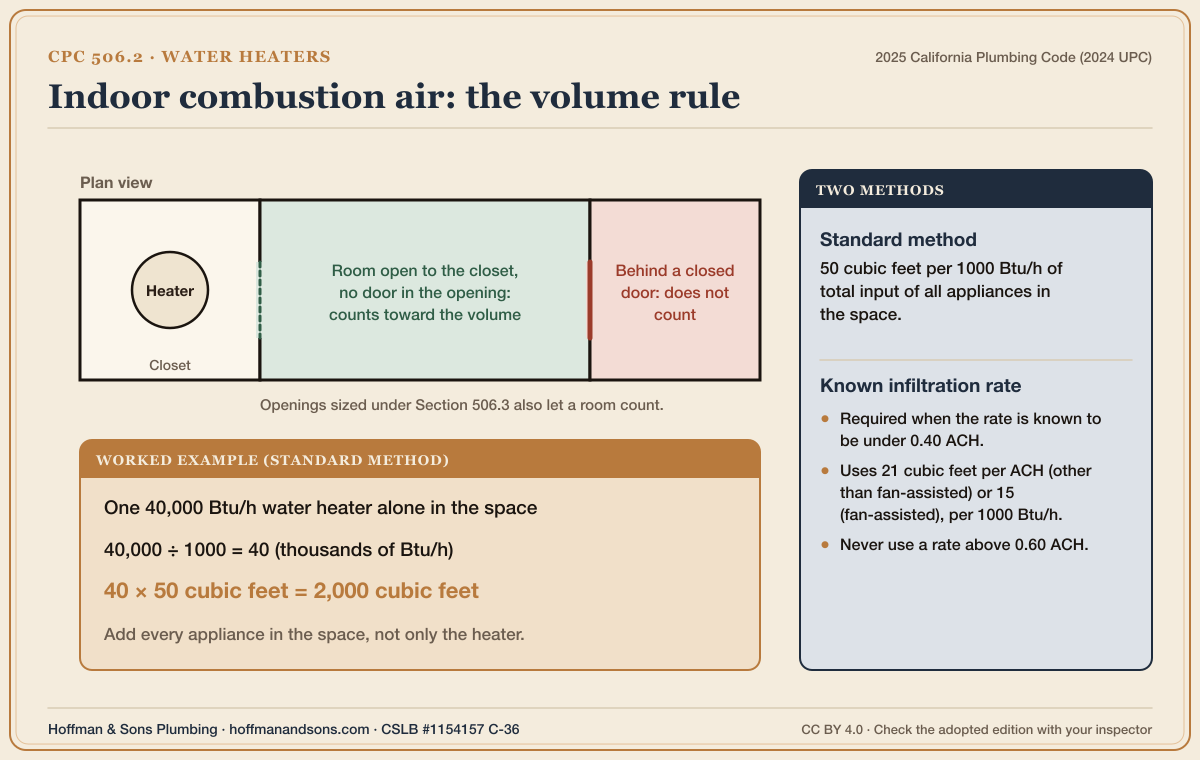
Indoor combustion air means the appliance gets its air from the house, so the space has to be big enough to supply it. Add up the input of every appliance in the space, not just the water heater, and the required volume is the sum for all of them.
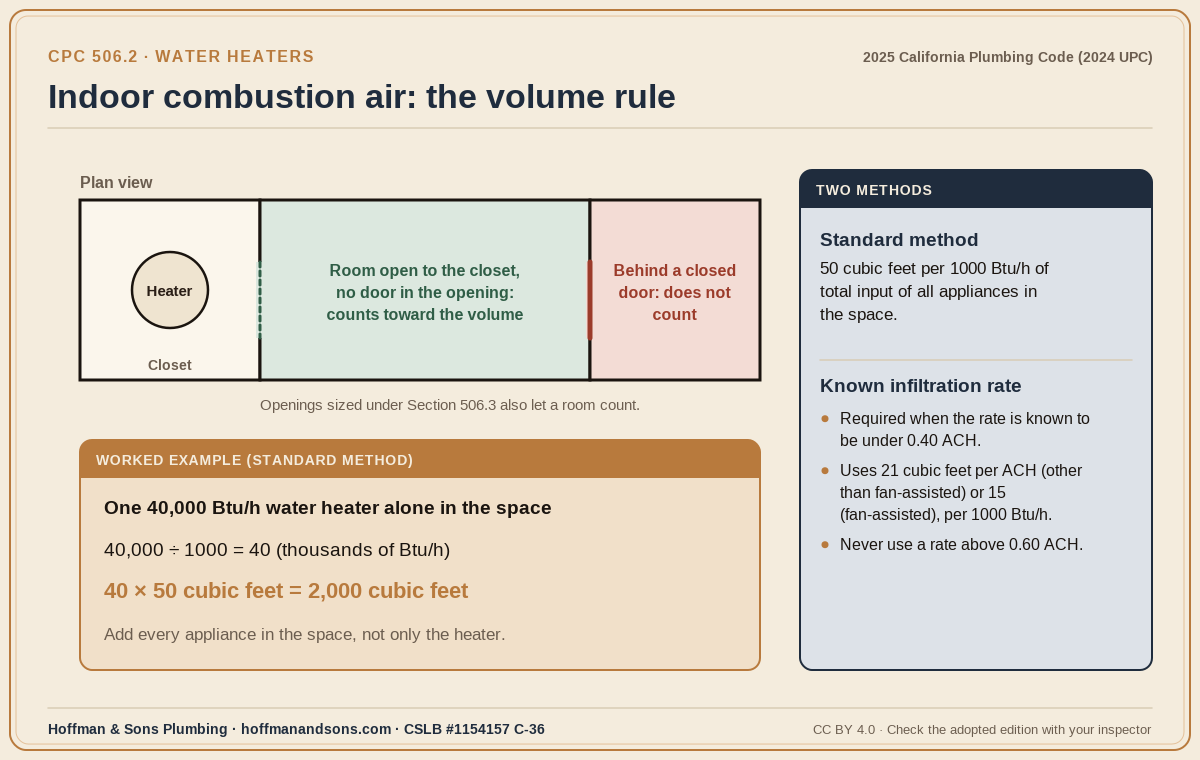
Standard method: 50 cubic feet per 1000 Btu/h. A 40,000 Btu/h heater alone in a space needs 2,000 cubic feet. Rooms that connect to the appliance space through openings with no doors, or through combustion air openings sized under Section 506.3, count toward the volume.
The known-infiltration method is for when you know the structure's air changes per hour (ACH). It's required when the infiltration rate is known to be under 0.40 ACH. The equation uses 21 cubic feet for appliances other than fan-assisted and 15 cubic feet for fan-assisted ones, multiplied by the input in thousands of Btu/h and divided by the ACH. You can't use an infiltration rate above 0.60 ACH in either equation.
When the volume isn't there, use outdoor air under Section 506.4. Direct-vent appliances are outside these rules entirely, because they bring their own air from outdoors.
On the job
- A water heater in a small closet almost never meets the volume by itself. Count the closet plus any room open to it without a door, or add openings under 506.3, or go to outdoor air.
- Add every appliance in the space. A furnace sharing the closet changes the math.
- Newer, tighter houses can fall under the 0.40 ACH rule, which is where the standard method stops working. When you don't know the rate, the inspector and the energy documents are the place to ask.
The inspector and your city's adopted edition have the final word.