The rule
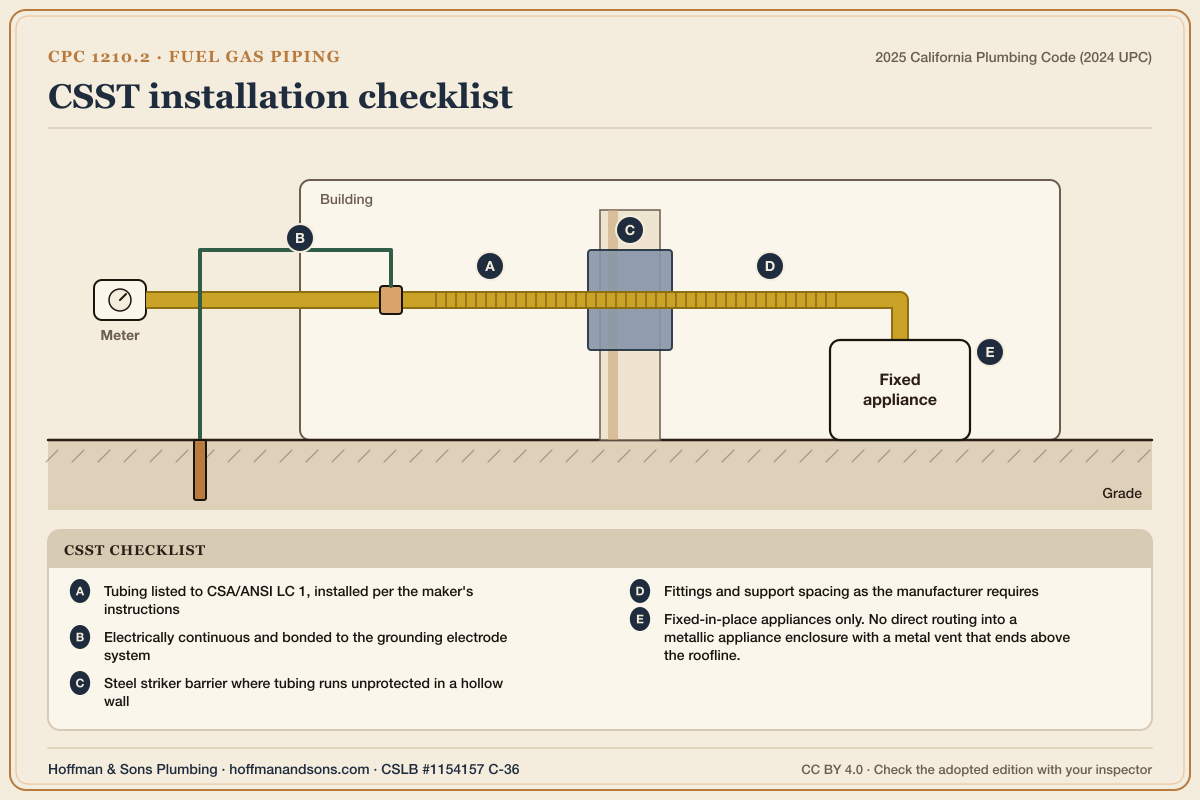
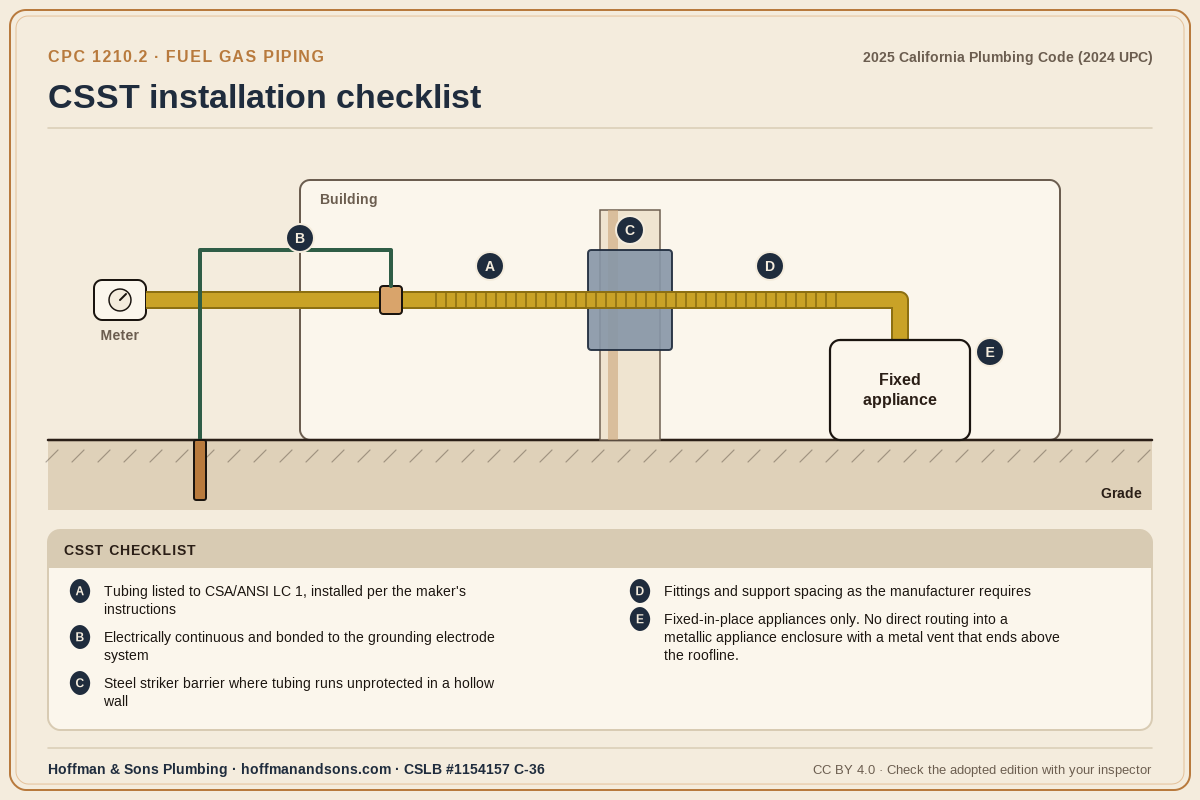
This section is short but it carries weight: CSST piping systems go in according to the code and the manufacturer's installation instructions. The maker's instructions become part of what the inspector checks, including fitting assembly, bend limits, support spacing and the routing rules.
The tubing itself has to be listed to CSA/ANSI LC 1/CSA 6.26. The fittings at concealed connections have to be CSST fittings listed to the same standard (Section 1210.4.1). Support spacing for CSST follows the maker's instructions, not the steel pipe table.
Other sections add to it. CSST systems have to be electrically continuous and bonded to the electrical service grounding electrode system (Section 1211.2). Tubing in a hollow wall without other protection needs a steel striker barrier (Section 1210.4.3). At an appliance, CSST can connect only to appliances fixed in place and can't be routed directly into a metallic appliance enclosure if the appliance connects to a metallic vent that terminates above a roofline (Section 1212.1).
On the job
- Keep the manufacturer's installation guide on the job. When the inspector asks how something was done, that's the document they'll want to see.
- Get the bonding done before the inspection, since the system has to be bonded when it's tested and signed off.
- Route the tubing so it isn't rigidly strapped in a hollow wall, and plan the striker barrier where it runs near the face of a stud.
- Check each appliance. A portable or movable appliance on CSST is a no.
The inspector and your city's adopted edition have the final word.