The rule
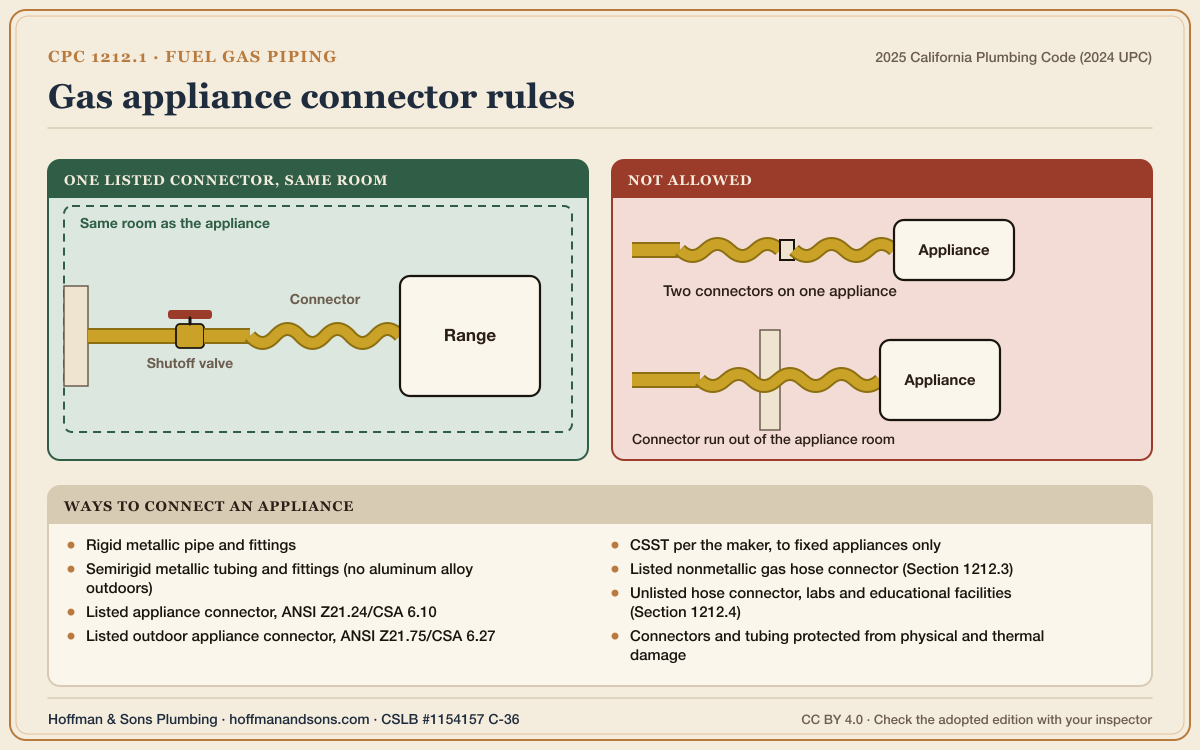
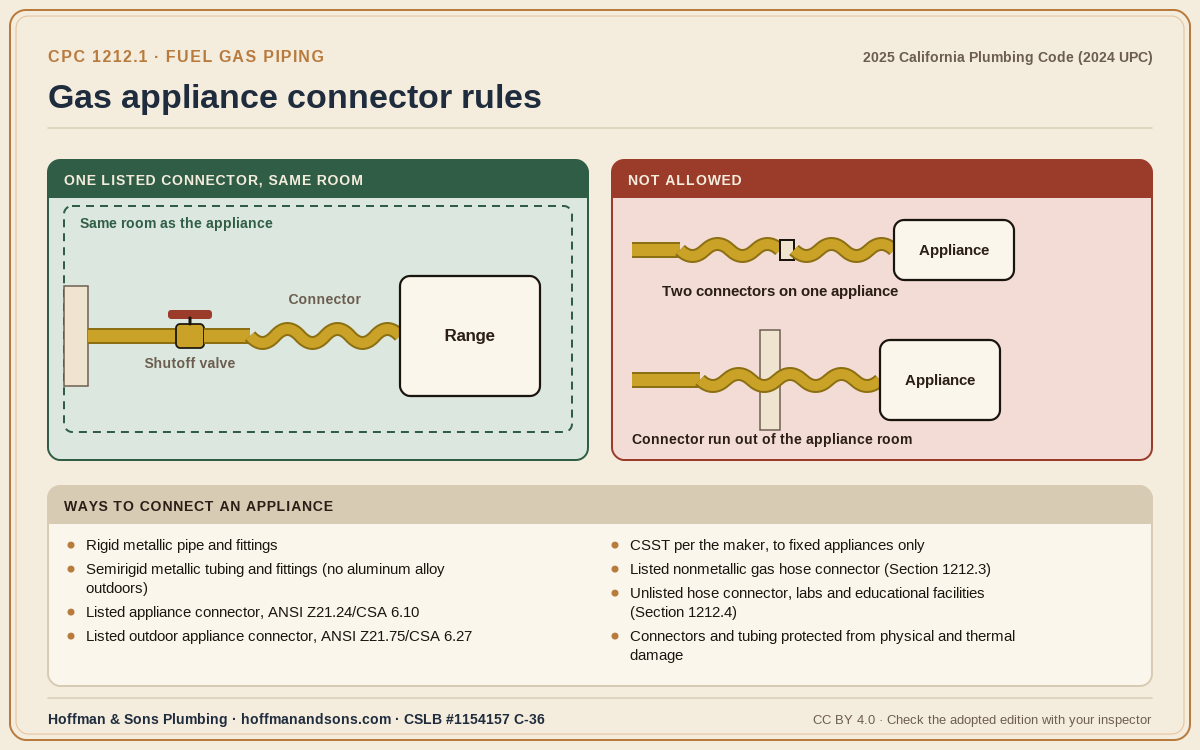
The code lists how an appliance can be hooked to the gas piping: rigid metallic pipe and fittings, semirigid metallic tubing and metallic fittings, a connector listed to ANSI Z21.24/CSA 6.10, a connector for outdoor appliances and manufactured homes listed to ANSI Z21.75/CSA 6.27, CSST installed per the manufacturer, listed nonmetallic gas hose connectors (Section 1212.3), or unlisted hose connectors for labs and educational facilities (Section 1212.4).
A listed appliance connector has to be used per the maker's instructions and has to be in the same room as the appliance. Only one connector goes on an appliance. The same one-connector rule applies to the outdoor connector.
CSST can't be routed directly into a metallic appliance enclosure where the appliance is connected to a metallic vent that terminates above a roofline, and it connects only to appliances that are fixed in place. Aluminum alloy tubing can't be used outdoors.
Connectors and tubing have to be installed so they're protected against physical and thermal damage. Aluminum alloy tubing and connectors are coated against corrosion where they contact masonry, plaster or insulation or get repeated wetting by detergents, sewage or water other than rainwater.
On the job
- Use a new listed connector sized for the appliance's input. Don't reuse an old connector on a replacement appliance unless the manufacturer's instructions allow it.
- Install the shutoff valve upstream of the connector, and make sure the connector is in the same room as the appliance, not run through a wall (Section 1212.6).
- Don't connect two connectors end to end to make a longer one.
- Look at where the connector sits behind the appliance. A kink or a crushed bend is the usual damage. Allow slack for moving the appliance only if the connector's listing allows it.
The inspector and your city's adopted edition have the final word.