The rule
Changes in direction can be made three ways: fittings, factory bends or field bends. Fittings are by far the most common on typical jobs, but the code sets rules for the bends.
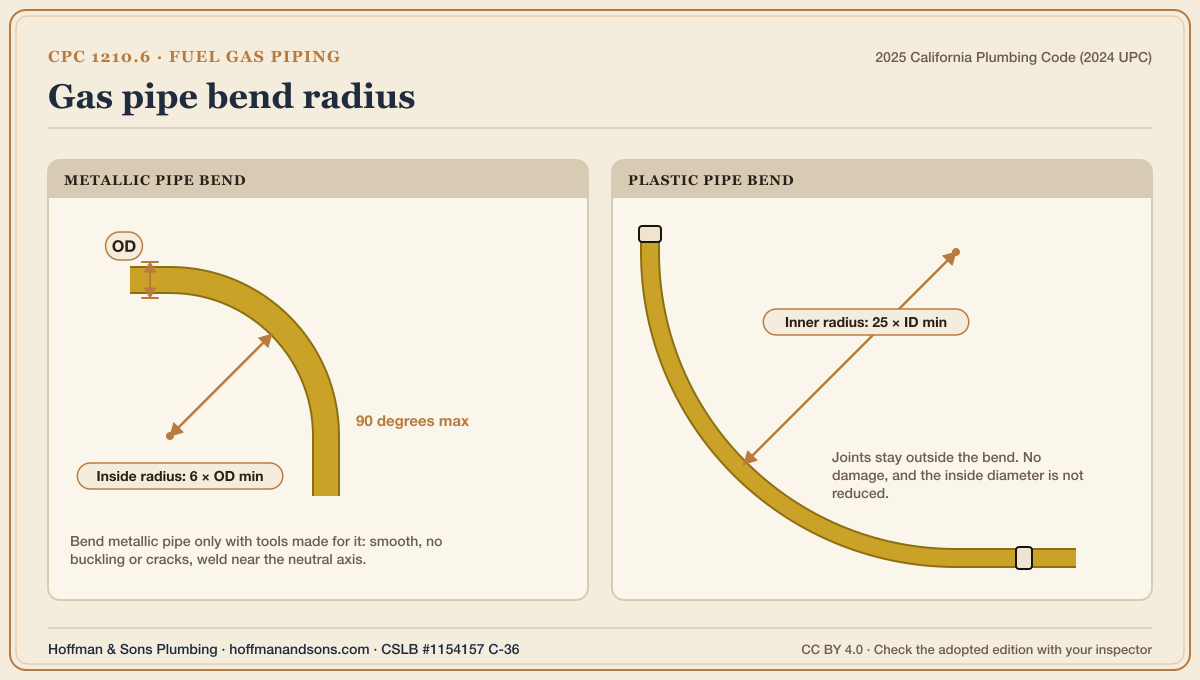
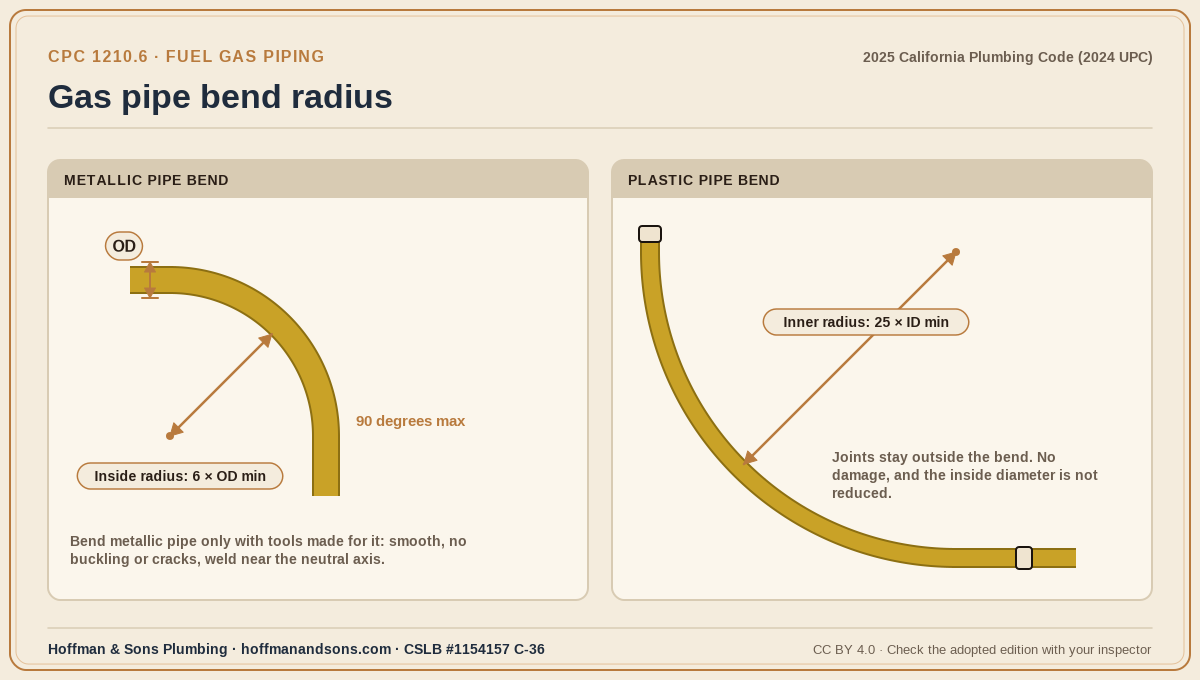
For metallic pipe, use bending tools and procedures made for the job, keep the bend smooth with no buckling, cracks or other mechanical damage, put the longitudinal weld near the neutral axis, never bend through more than 90 degrees, and keep the inside radius at least 6 times the outside diameter of the pipe.
Plastic pipe bends can't damage the pipe or effectively reduce its inside diameter. Joints don't go in bends, the inner radius is at least 25 times the inside diameter, and any special bending tools the maker specifies are used.
Factory-made welding elbows, or segments cut from them, need an arc length of at least 1 inch measured along the crotch for pipe 2 inches and larger.
On the job
- Bends are made with tools and procedures meant for the job. A kinked, flattened or cracked bend is a rejection.
- For small steel pipe, it's usually faster and cleaner to use a fitting than to bend. Bend radius adds up fast: a 6 times radius on 1 inch pipe is a wide sweep.
- On plastic, plan the layout so the joint falls in a straight run before and after the bend.
- Mind the weld seam on welded steel pipe. It sits near the neutral axis of the bend, not on the outside or inside.
The inspector and your city's adopted edition have the final word.