The rule
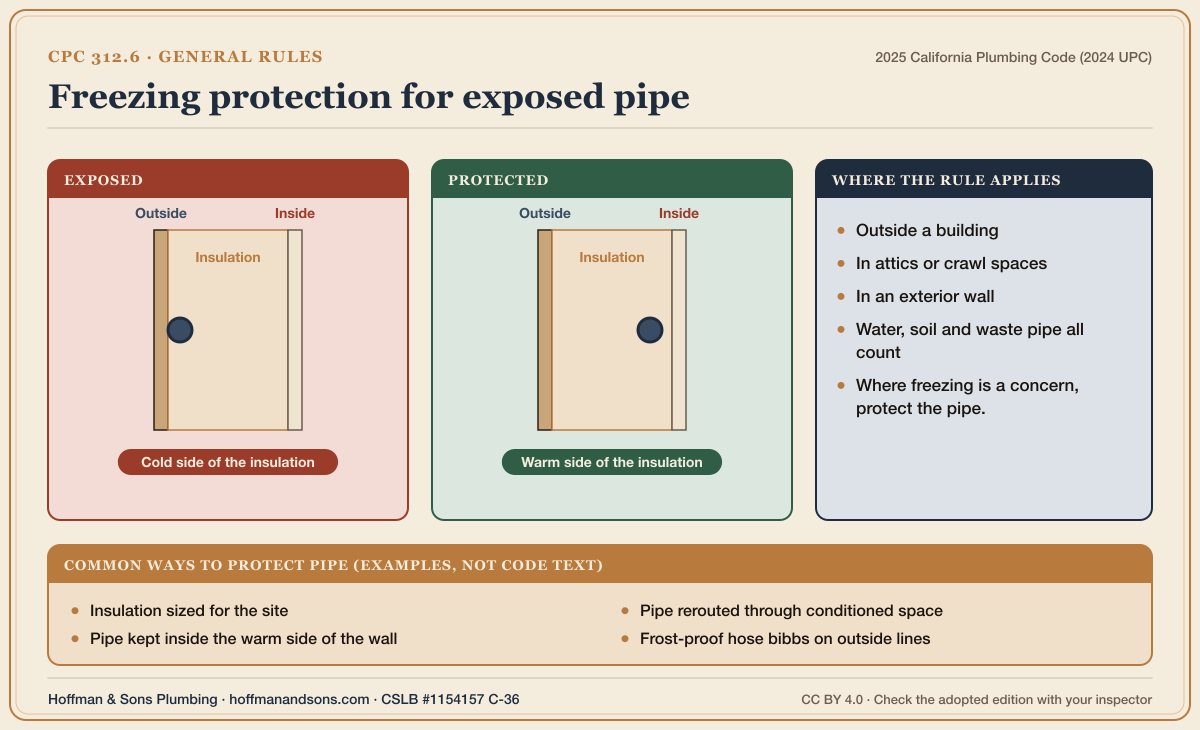
The code doesn't hand you a temperature, a burial depth or an insulation value. It names three places that are exposed to cold (outside the building, attics and crawl spaces, and exterior walls) and says that where freezing is a concern, you have to make adequate provision.
The rule covers supply lines, and it also covers soil and waste pipe. Water that freezes in a drain can split pipe the same as it does in a supply line.
What counts as necessary depends on the site and the winter conditions, so the inspector and the city's adopted edition set the expectation. The usual tools are insulation, keeping pipe on the warm side of the building envelope, burying pipe, or relocating it.
On the job
- In an exterior wall, keep the pipe on the warm side of the insulation, not between the insulation and the sheathing.
- Attic and crawl-space piping at inland or higher-elevation sites usually wants insulation, or a different route through conditioned space. Ask the inspector what they expect for the area.
- Outdoor hose bibbs and any exposed outside piping are the first places to split in a hard freeze. Frost-proof bibbs and drain-down points are worth the extra cost.
The inspector and your city's adopted edition have the final word.