The rule
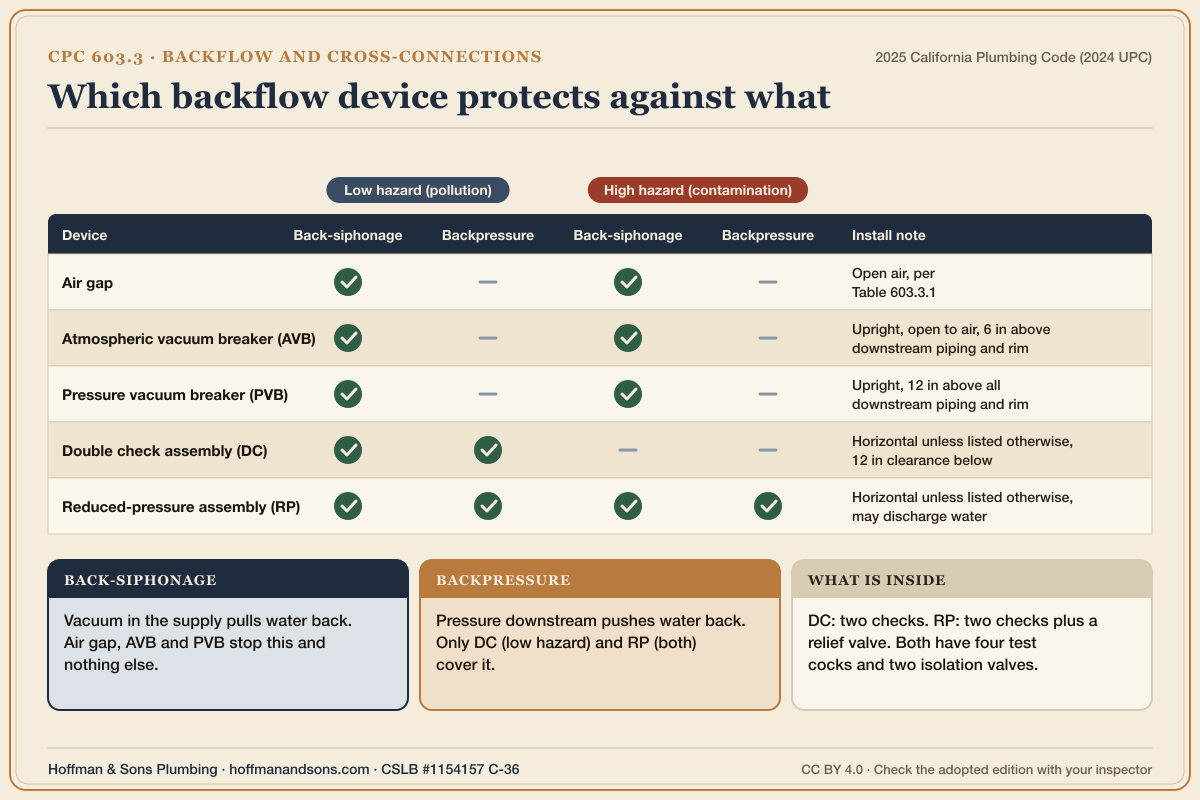
Start with two questions. How bad is the hazard: pollution (low hazard) or contamination (high hazard)? And which way could the backflow go: back-siphonage (a vacuum in the supply) or backpressure (pressure downstream pushing back)? Table 603.2 answers both for each device.
An air gap and an atmospheric vacuum breaker (AVB) handle back-siphonage only, at both hazard levels. A pressure vacuum breaker (PVB) does the same, and has test cocks and shutoff valves. A double check assembly (DC) handles back-siphonage and backpressure, but only at the low hazard level. A reduced-pressure principle assembly (RP) covers both directions at both hazard levels, which is why it's the one chosen for high hazards.
The assembly definitions in 603.3.1 through 603.3.12 set what has to be inside. An RP is two independently acting loaded check valves, a differential pressure relief valve, four test cocks and two isolation valves. A DC is the same without the relief valve. A PVB has a loaded air inlet valve, a loaded check valve, two test cocks and two isolation valves. An AVB is a body, a checking member and an atmospheric port.
The table has installation notes too. An AVB goes upright, open to air, at least 6 inches above downstream piping and the flood-level rim. A PVB goes upright, at least 12 inches above them. DC and RP assemblies go horizontal unless listed otherwise.
On the job
- Read the hazard first, then the device. Chemicals, boilers with additives and anything that could back up with something toxic is high hazard, and that's RP territory.
- An RP can discharge water from its relief port, so plan the drain and the floor before you set it. Same for a PVB.
- AVBs can't have a shutoff valve downstream and can't be under constant pressure, so they live right at the outlet. For anything continuously pressurized, look at a PVB, DC or RP.
- Each device has a mounting orientation in the table. Upright means upright, and the 6 inch and 12 inch figures are minimums.
The inspector and your city's adopted edition have the final word.