The rule
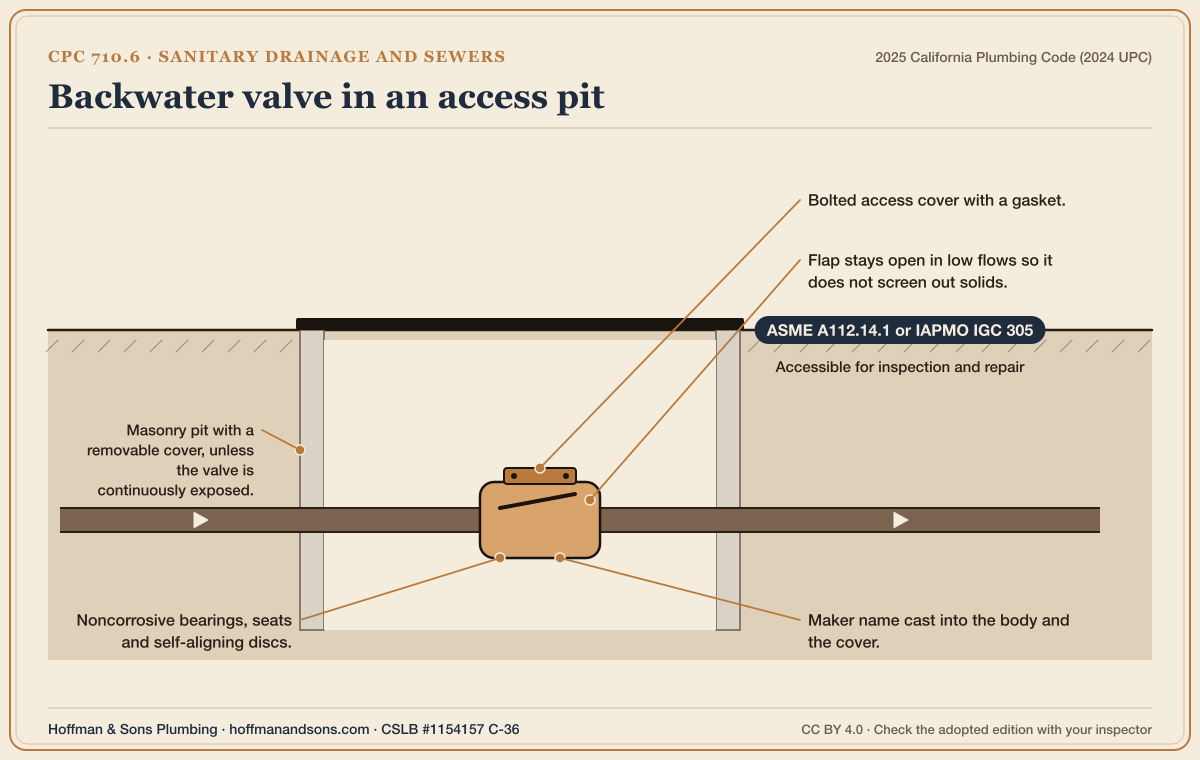
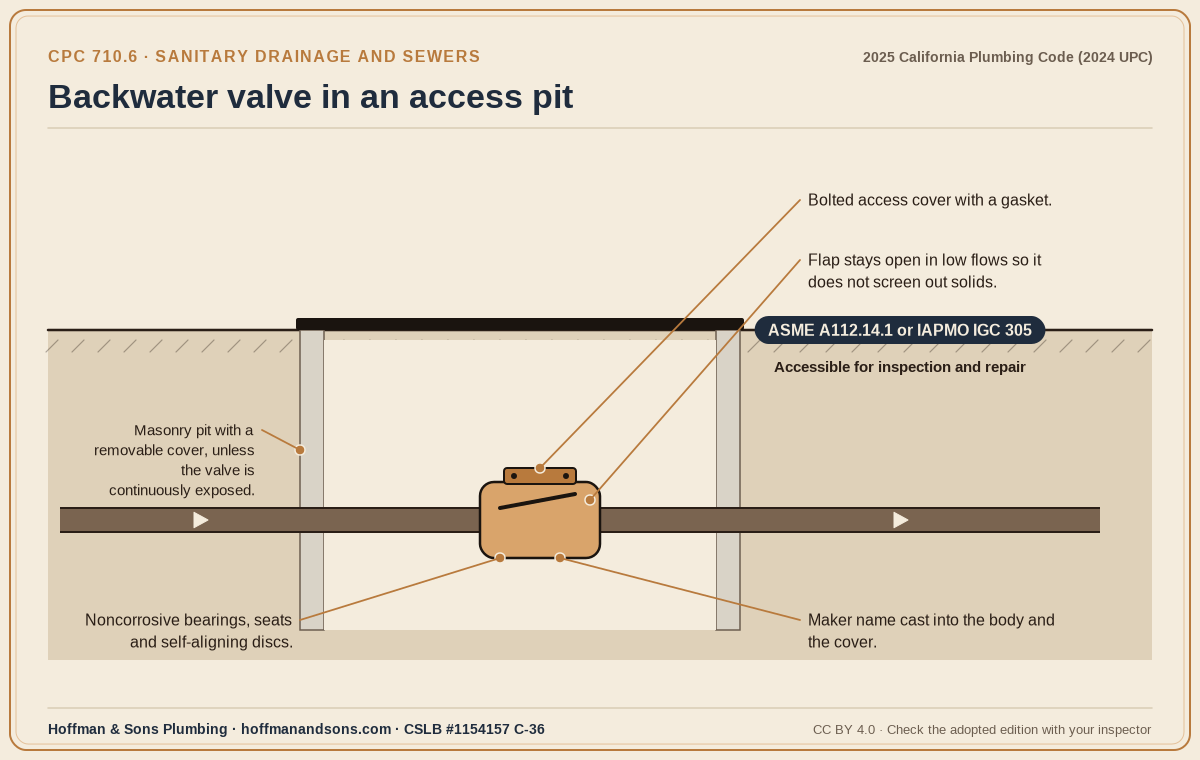
A backwater valve that can't be reached is a valve that won't get maintained. Backwater valves, gate valves, fullway ball valves, unions, motors, compressors, air tanks and other mechanical devices required by Section 710 have to be accessible for inspection and repair. Unless they're continuously exposed, they go in a masonry pit with an adequately sized removable cover.
The valve itself has to comply with ASME A112.14.1 or IAPMO IGC 305 and have a cast-iron, plastic, copper alloy or other approved body. It needs noncorrosive bearings, seats and self-aligning discs, and a positive mechanical seal.
It has to stay open during low flows so it doesn't screen out solids, and it can't restrict capacity or cause excessive turbulence at peak load. Unless listed otherwise, the access cover is the bolted type with a gasket, and the maker's name is cast into the body and the cover.
On the job
- Decide where the access pit goes while the floor or yard is still open. A buried valve with no pit is a rejection, and it's a hard fix.
- Check that the maker's name is cast into both the body and the cover before you set it. The code requires it on both.
- Pick a valve that meets A112.14.1 or IGC 305 and read its instructions for the pit size it needs, so the cover and the clearance are right the first time.
The inspector and your city's adopted edition have the final word.