The rule
California's 603.5.14 reads differently from the base code. It carries a note that the State Fire Marshal hasn't adopted the model code's fire-system backflow language, and it points to California Health and Safety Code 13114.7 instead.
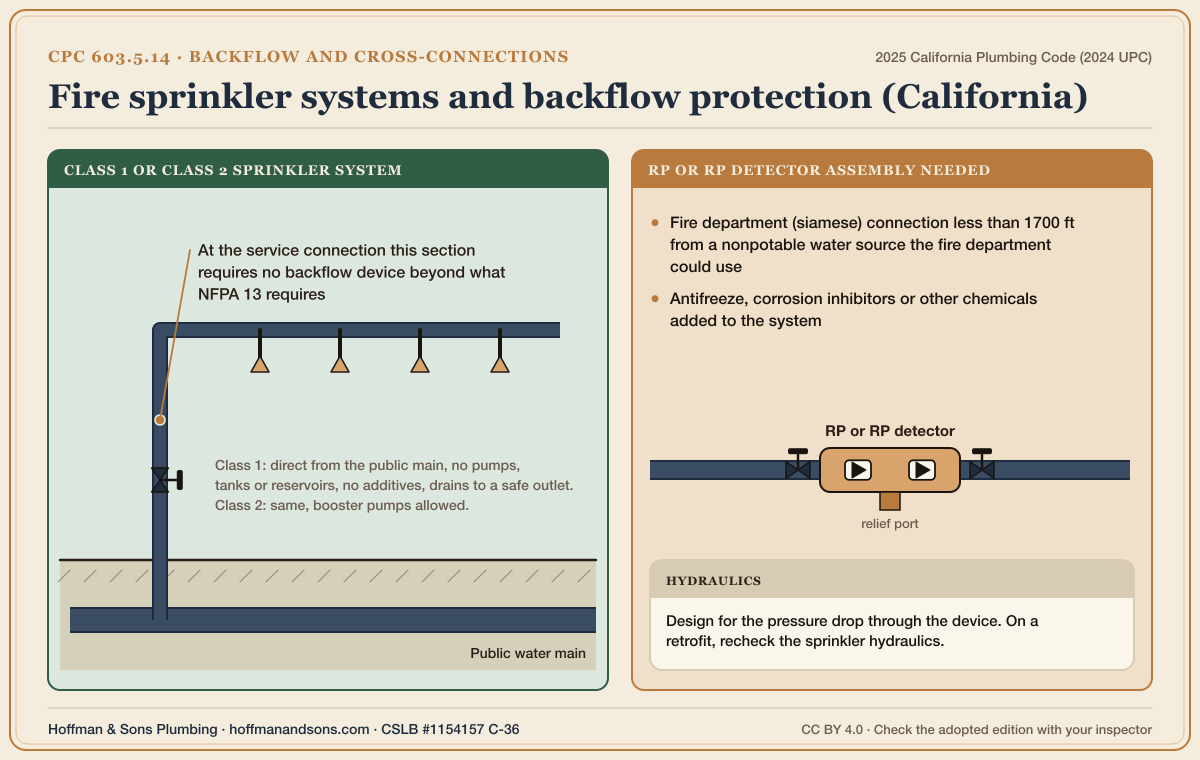
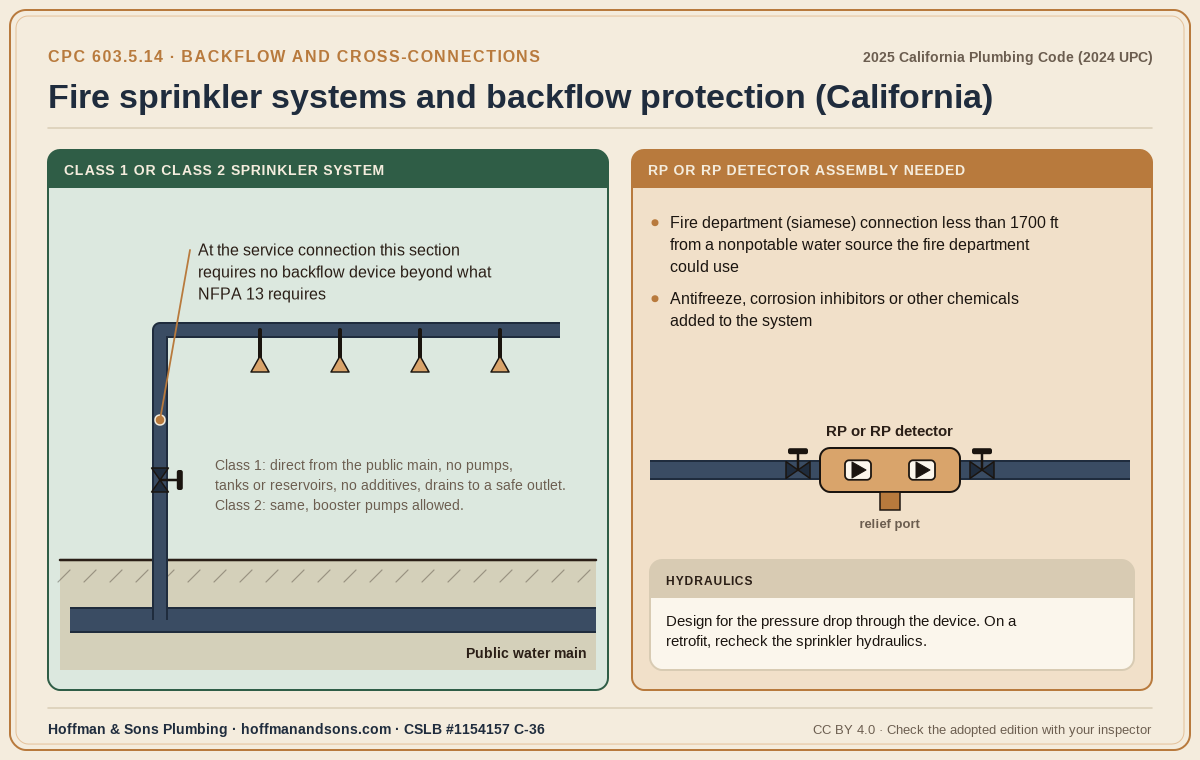
That law defines two kinds of system. Class 1 is an automatic sprinkler system connected directly to public water mains only, with no pumps, tanks or reservoirs, no connection to other water supplies, no antifreeze or additives, and with all sprinkler drains discharging to the atmosphere or other safe outlets. Class 2 is the same, except that booster pumps are allowed in the connection from the street mains. Both need no backflow protection at the service connection other than what the NFPA 13 standard cited there requires.
The rest of the section still applies. If a fire department (siamese) connection is less than 1700 feet from a nonpotable water source the fire department could use, or where antifreeze, corrosion inhibitors or other chemicals are added to the system, the potable supply gets an RP or an RP detector fire protection assembly.
Where a backflow device is installed, the system's hydraulic design has to account for the pressure drop through it. When one is retrofitted to an existing system, the sprinkler hydraulics are checked to confirm there's enough pressure for the sprinklers to work.
On the job
- Work out which class the system is before you assume anything. A pump, tank, additive or a second water source moves it out of class 1 or 2.
- Fire sprinkler design is a separate trade and approval path. Coordinate the backflow assembly and its pressure drop with the fire sprinkler designer early, not at final.
- Detector assemblies are bigger and heavier than they look. Plan the room, clearance and platform per 603.4.3 before the slab or framing is set.
- The fire authority and the Authority Having Jurisdiction have the final word on which path applies to a specific building.
The inspector and your city's adopted edition have the final word.